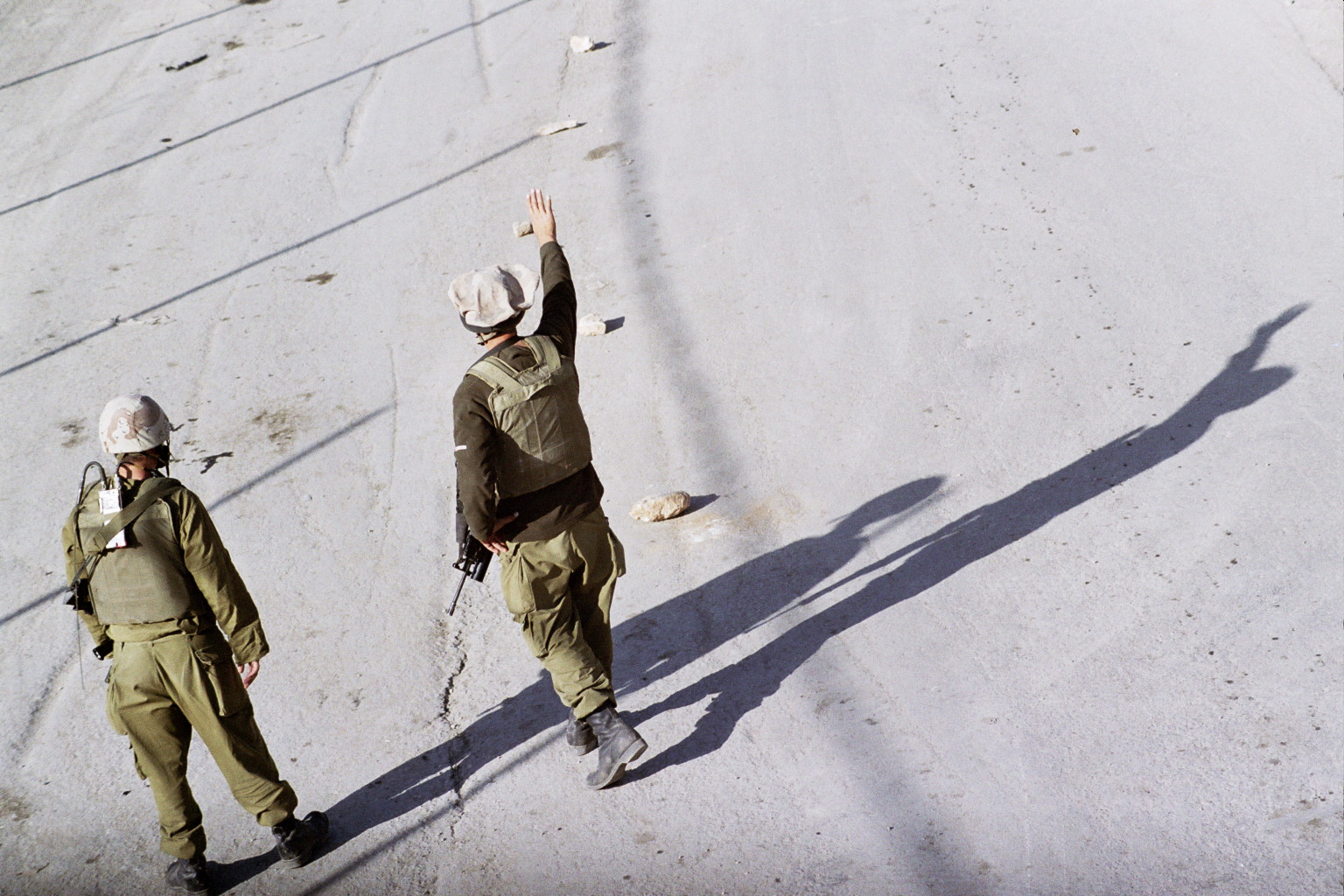
I think that while we were still in basic training, at Tel Arad, a settler was murdered, I don’t remember exactly where. He was a shepherd. He had been missing since the afternoon hours [Note: the interviewee is referring to Yair Har Sinai who was murdered around Susiya]. His flock made it home without him. The goats and sheep made it back, he didn’t, and we were alerted. It was already evening and various forces in the area began to survey the region. At the time, I was our company commander’s signalman. We walked around with flashlights, not knowing what we were supposed to look for – anything, a piece of clothing. Finally one of my mates, without noticing, actually stepped on his body in the middle of the night, perhaps at dawn. From that moment, we waited at one of the settlements around there, and first thing in the morning, they came to speak to us. I remember it was the company commander who spoke to us. If the company commander speaks to soldiers in basic training it’s already... He said the settler was murdered by Palestinian terrorists who were hiding in all sorts of places nearby – there are lots of not really houses but half-caves with shanties added on, all sorts of improvised tin shanties out of every piece of junk that can be used. The company commander told us that the local residents aided and abetted the terrorists to hide out, or I don’t know what. One of the things I remember from this motivation talk which clarified for us beyond a shadow of a doubt that the residents really aided them and that there was all sorts of proof and tracks leading to them and stuff like that. Again, I think he knew it was not true when he told us this, because none of us bothered to doubt what he was saying. The army, the Shin Bet and intelligence probably know what they’re talking about. He asked if anyone had any problem carrying out the mission and that if so, he should speak up now, or something like that, and it was followed by threats about refusing army orders. No one said a word. Actually we were out from the early morning hours, going through every place where Palestinians lived out there, and we secured bulldozers and wheel loaders that simply flattened those hamlets, and there were no men around. It was a kind of... Not exactly an encampment. These were tiny little shanties, the poorest you could imagine, usually containing a sack of rice, a few wretched pots, pieces of tin used as partitions, sometimes a little corral with some livestock. There are raggedy carpets... The men weren’t there, only women and children, and we let every family have 10 minutes, no more, to take out whatever they could. Together with their kids they were on the run, dragging out everything they could manage to carry. In some cases, it went more smoothly because they must have been prepared. They didn’t resist and we never used our weapons.
How do you mean "resist"? Weeping, yelling, cursing. As soon as the men were not there, as it was only the women and children, a few dozen soldiers stood there around the wheel loader and went from hovel to hovel, there wasn't much to do. I remember the sealing of two wells, with a wheel loader. It simply came and covered it up with rocks and dirt.
Did you see what happened to the people? Did they go anywhere? No, they remained. At the end of the day we depopulated some hamlets that were closer to small villages, all the localities were scattered in the hills and at places closer to villages lots of villagers came to protest our action. So all these people were standing very close to us as we stood guard. We were guarding that wheel loader, securing it, but in this case too there was no shooting. We just threatened them and there was nothing much they could do. It was a bit stressful for us as trainees that people were coming out, even if they were unarmed, but finally nothing more happened.
How many hovels do you think you destroyed? Dozens. Dozens. That’s the only event I actually remember from my basic training days.






 testimonies
 media & content




 We secured bulldozers and wheel loaders that simply flattened those hamlets


 terms of use & privacy policy